The presentation is clear. Someone asks a question from the back without a microphone; the speaker answers before they finish; another person adds a comment. Translation listeners receive an answer without receiving the question. Even when the presentation works, the exchange can fail at the speaking turns.
To translate a bilingual meeting with questions and answers, define the translation direction, capture every contribution and moderate the turns. A session taking a Spanish presentation into English should not be advertised as an automatic two-way conversation. This guide provides a manageable format for participation.
Map the route before choosing a tool
Imagine a Spanish talk with listeners following translation in English. MoriahTech IA can deliver that target through a session joined by public QR code or link. Listeners hear audio and read captions in their browser without installing an app.
Each session has one target language. This does not establish automatic translation in both directions for every intervention. If you need free discussion with frequent language changes, define another operation and check that the solution covers it before purchasing.
Scroll the table to see every column.
| Situation | Operation to prepare |
|---|---|
| Spanish speaker and questions; audience listening in English | A Spanish → English route receiving both microphones |
| English question; speaker answering in Spanish | Bilingual moderator restates it in Spanish and confirms meaning |
| Debate with constant language changes | Suitable interpreting and channels; consider professional support |
| Audience needing several simultaneous target languages | Specific configuration and capacity; do not assume one channel |
The human, remote and AI interpretation comparison helps when mediation and nuance matter. For an orderly talk, start with the route you can rehearse.
Three ways to capture questions
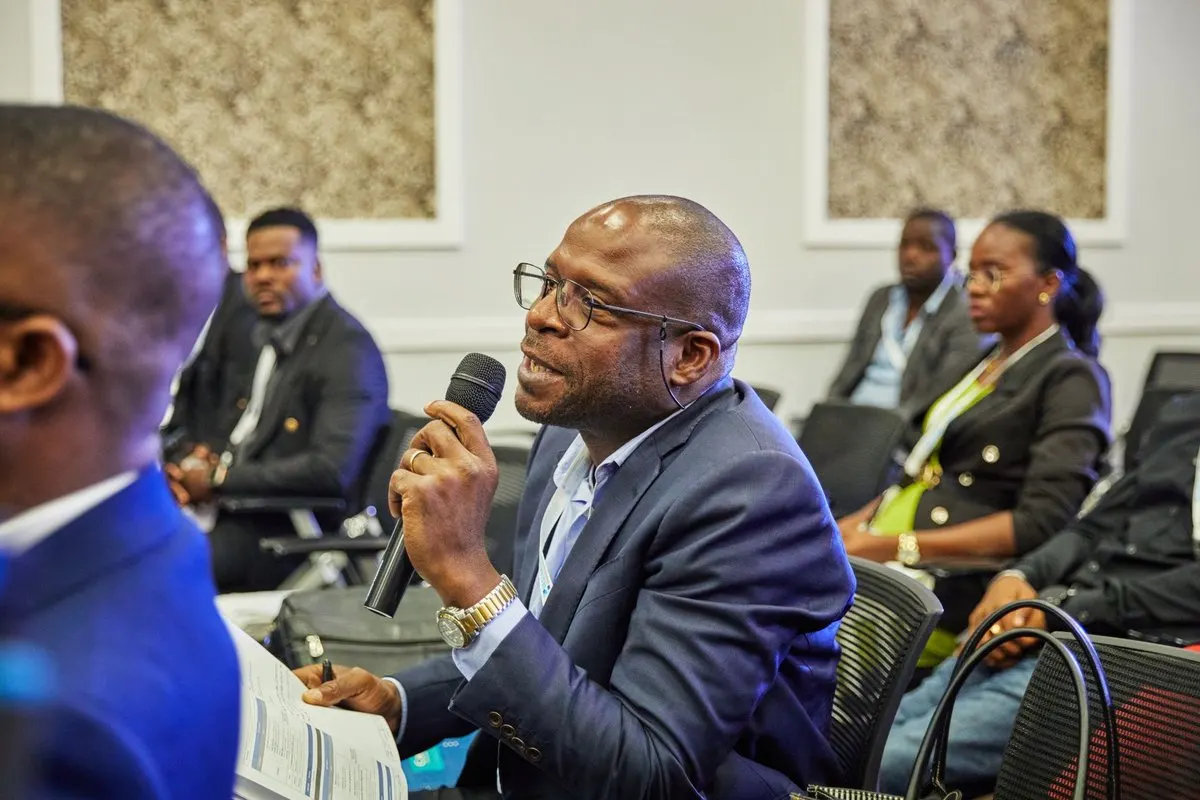
An audience microphone connected to the input
This can suit a session with many interventions. The technician must verify that both the audience microphone and the speaker microphone reach the input used for translation. Hearing them through room loudspeakers does not establish that they reach that output.
Ask participants to wait for the microphone. The moderator gives the turn while the operator checks the first question on a listening device. Keep translated audio out of the original input so the system does not receive its own output.
The moderator repeats each question
Without a second microphone, the moderator can repeat the complete question through their microphone before the speaker answers. Explain this procedure at the beginning and confirm with the participant that the restatement is faithful.
“They are asking about the budget” is insufficient if the question was “Does that price include three sessions or just one?” That distinction changes the answer the audience needs.
Written questions read by the moderator
Collect questions on cards or through an external tool chosen by the organiser. The moderator reads them in the source language and checks ambiguities. This is not a question collection or automatic question translation feature attributed to MoriahTech IA.
Shure’s meeting room microphone guide connects intelligibility with distance, room acoustics and microphone placement. Here, check the questioner’s voice as well as the speaker’s.
Give the moderator a usable script
Agree on four rules: one contribution at a time, the complete question, time for translation and confirmation after restatement. Adapt this opening:
We will take one question at a time. Please wait for the microphone or for me to repeat your question. If you ask in English, I will restate it in Spanish and confirm the meaning with you before the answer. We will leave a pause so translation listeners can follow the exchange.
Adjust the pause to the actual rehearsal. Do not promise a fixed number of seconds across every language, network and device. Ask the speaker to answer in short sections and identify which question they are answering.
If a number, name or negation arrives incorrectly, correct the detail and repeat the sentence. Do not build the next answer on meaning you know is wrong.
A 70-minute programme you can adapt
This hypothetical example has a five-minute introduction, a 45-minute presentation and twenty minutes of questions. Twenty people listen to translation; the presentation stays in Spanish.
A helper checks the public English listening link from the audience area. During questions, participants use the audience microphone. If someone asks in English, the bilingual moderator restates the question in Spanish. The speaker answers in Spanish and the session delivers English to listeners.
Scroll the table to see every column.
| Section | Planned minutes of speech sent |
|---|---|
| Welcome | 5 |
| Presentation | 45 |
| Questions and answers | 20 |
| Programme total | 70 |
For conservative capacity planning, reserve those seventy minutes plus rehearsal and margin. Do not subtract pauses as confirmed savings. Use the translation minute planning guide and check how your operation is counted.
The programme fits the trial’s numerical limits if sufficient balance remains: 14 days without a card, 180 total minutes, three sessions, up to 120 minutes per session, 25 listeners and one concurrent session. Other rehearsals must also fit. The five-minute technical check uses minutes without counting as a session. With more than twenty-five listeners, the free rehearsal does not cover full audience capacity.
Rehearse the part that is often missed
- Ask from the back row. Use the planned audience microphone or moderator repetition. Listen from another device and check the complete question arrives.
- Ask in the other language. Have the moderator restate it, obtain confirmation and wait before the answer.
- Include a number and negation. For example: “Does the workshop admit fifteen people? I am not asking about conference capacity.” Check that the distinction survives translation.
- Simulate an interruption. The moderator returns the turn to one person and repeats anything lost.
- Check listener recovery. Pause and resume on the intended devices. Finish the session in the panel and confirm its state at the end.
Record the failure, change and second attempt. The event preparation checklist supports audio, access and responsibilities. A presentation rehearsal without questions leaves the most interactive section untested.
When to choose another format
Consider professional interpretation for negotiation, official proceedings or a debate where every nuance determines a decision. If everyone needs to speak freely in both languages, design that mediation and its channels from the start.
Reconsider the operation if nobody can moderate, voices overlap continually or audience audio cannot reach the input. Choose a format your team can support.
Rehearse before buying capacity
Start with one question of each type and listeners who can assess meaning. Create your account to rehearse the bilingual meeting. Testing the whole route gives you your own example for deciding.
For more listeners or several sessions, compare event translation packs. Creating an account does not activate a pack: it requires a request, payment and validation. Check minutes, session count and duration, listeners, concurrency and target language before announcing coverage.